
Writing Cloud Eaters: An Interview with Nate Miller
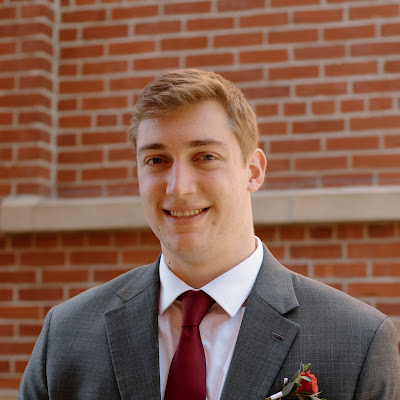
Nate Miller is an alumnus of New Saint Andrews College who recently published his first book, Finn and the Cloud Eater. We asked him about the story behind the story, and are happy to present that to you here.
Can you tell us about your background and what led you to where you are now?
My family moved to Moscow in 2010 from southern Illinois. After graduating from Logos School, I attended NSA and graduated in 2023. I am currently in the MA program and serve as the Director of Recruitment at NSA. I'm married to an NSA grad (Elli) and have two young giant slayers.
On to your book, Finn and the Cloud Eater. Could you give a synopsis of the story?
When Finn, a young shepherd, trespasses on a forbidden lake, he angers the giant Iteoir Scamall, who steals all the clouds from the sky. Finn must kill the giant before the land dries up for lack of clouds.
How did you settle on this specific plot/setting? The target audience? Characters?
I have always loved mythology and European folklore. I grew up on a steady diet of d'Aulaires books of Greek and Norse myths and competed many times in the National Mythology Exam. More recently, I've gotten into Irish myths and folklore. Fionn Mac Cumhail (pronounced "Finn McCool") is a recurring character throughout Irish folklore and epics—an Irish King Arthur with his own round table of sorts. In this story, I've made Finn a boy from a world like ours that falls into the lake into a kind of faerie land, Alice-through-the-looking-glass style. I stole one character from The Faerie Queen and a handful from Greek mythology, including the East Wind, who I think has always been overshadowed by his older brother.
I chose a younger audience for two reasons: first, children’s literature allows for a story with a fairly basic plot structure. I could focus more on setting and characters throughout. The second is that we need more children’s chapter books—especially fantasy, and especially stories for boys with high stakes and danger. This age range in particular just chews through literature, and it’s all parents can do to find a series they can trust and let their kids go for it. That’s why there are—I kid you not—164 Boxcar children books and 100+ Magic Treehouse books. Three will be plenty for Finn.
Describe your writing process.
This specific story grew from a single image (a little like Chronicles of Narnia growing from the image of a faun carrying packages in a snowy wood). Many of my story ideas, like this one, arrive partially formed while I'm listening to a sermon. The picture in my head was of a giant standing in front of a boy, who has a great whip curled over his head in the shape of a question mark.
In terms of the actual construction of the story, I tend to follow where it goes. I have a loose structure in my head—really, it's more like I know a few different scenes/plot pieces and where they need to go, then write my way from one to the next. Writing for me is more like following a path marked with cairns (actually another word derived from Irish!), where the cairns are conversations or scenes or plot pieces that I know need to happen. Then… edit, edit, edit without sucking the life out of it.
How did your NSA education contribute to writing this book?
Reading the classics for sure. You begin to learn what kinds of stories stand the test of time and what don’t. Latin contributed to a richer vocabulary (and struck me down for being pretentious…though maybe that was just Mr. Griffith) and Apuleius is a genius. Persuasive Writing with Dr. Grieser made me rethink how I approach grammar, though unfortunately I also learned to use and love em dashes in that class… now indelibly the mark of the AI beast. Theology gave me the proper presuppositional foundation to add some hearty nutritional value to the story and philosophy helped with polyphony—giving my characters some depth and their own voice.
What did you learn or discover while working on this book?
Writing is mostly theft. Actually, that’s another thing that reading the classics teaches you; everyone quotes and refers to Scripture, the Great Story, constantly, and steals from other great stories. I take situations from Scripture and play it out in a new setting. I smuggled the giant in from a folklore story. George MacDonald would chuckle at some trinkets I took from The Princes and the Goblin and Homer could probably sue for copyright infringement.
Call it what you will: homage, allusions, theft, or what have you. I think it maps on pretty well to what Tolkien calls the “leaf-mold of the mind,” a sort to subconscious repository of everything we’ve learned and read that germinates “new” ideas birthed from the old stories.
What advice do you have for NSA students who are considering going into writing?
Be a hardworking thief. Actually write, and don’t just talk about it (I’m still working on that). Get married and have babies that you need to feed. And don’t just read old stuff—you have to see what’s out there and what people are actually reading. Find other writers. Learn how to finish a story, rather than starting a new story and getting 10k words in before flitting to a new idea. I say this having more than enough of those documents in my Google drive…
Are you working on any new projects now that your first book is published? Where can people follow what you're up to?
Yes. Finn is the first of a trilogy, so I'm continuing work on the next two. I'm also introducing and writing a reader's guide to a collection of American short stories with Roman Roads. I'm in the midst of a standalone middle grade novel. If you want some behind the scenes info on projects and writing updates, you can check out my website and subscribe to The Writer's Dozen, a monthly newsletter that Elli and I write.
Lastly, where should people get Finn and the Cloud Eater? (Amazon, Barnes & Noble, The Sword & Shovel, etc).
Right from the publisher is great—Nogginnose Press. They're great people over there. As a side note, you really ought to consider shifting from a consumer mindset to a patron mindset. Be thinking about where your money is going and who you're supporting. Sure you can buy it on Amazon... maybe for a few bucks cheaper. But who do you want to support? As a disclaimer I don't make any more commission from them if you buy directly from them, Amazon, or elsewhere. Otherwise, it's on most major online bookstores and in the Sword and Shovel.
Thanks so much, Nate! And for anyone looking for good Christmas gifts, consider gifting a loved one a copy of Finn and the Cloud Eater.
Merry Christmas from the Tyndale Library Staff!


Comments